

Picture this: You are rushing out the door on a hot Baytown, Texas morning. You press the button on your garage door opener, expecting the door to glide up so you can back out and head to work. Instead, you hear a massive BANG! that sounds like a firecracker went off inside your garage. The motor hums and strains, but the heavy door barely moves an inch.
If this sounds familiar, you are likely dealing with a broken garage door spring.
As an experienced garage door technician with 15 years in the field, I have seen exactly this scenario hundreds of times. Your garage door is the largest moving part of your home. It can easily weigh between 150 and 300 pounds. The opener motor doesn't actually do the heavy lifting—the springs do. When a spring fails, you are quite literally stuck.
In this comprehensive guide, we are going to dive deep into everything you need to know about garage door spring repair in Baytown, TX. We will cover how to identify a failing spring before it snaps, the differences between spring types, why the Texas Gulf Coast weather plays a role, and why replacing them is a job best left to the professionals at McLeod Overhead Doors and Springs.
Understanding Your Garage Door Springs
Before you can spot a failing spring, it helps to understand what kind of system you have in your garage. Most residential garage doors use one of two main types of spring systems: Torsion Springs and Extension Springs.
1. Torsion Springs
Torsion springs are the most common and safest type of spring system used on modern garage doors. If you stand inside your garage and look directly above the closed door, you will see a long metal shaft running parallel to the top of the door. Wrapped around this shaft is one (or sometimes two) tightly coiled, heavy-duty springs.
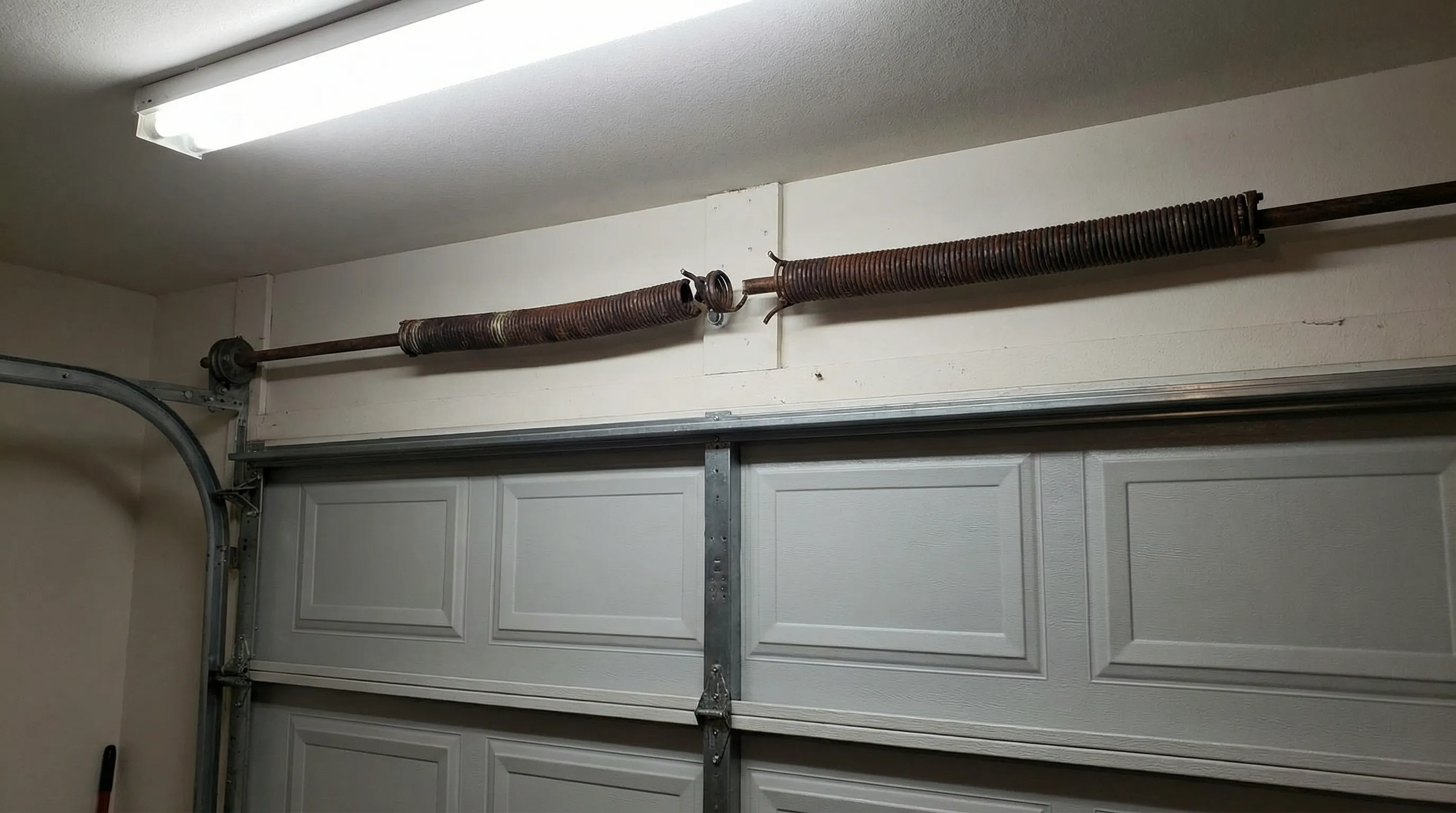
Torsion springs work by twisting. When the door is closed, the spring is wound up tight, storing a massive amount of rotational energy. As the door opens, the spring unwinds, releasing that energy to lift the heavy weight of the door. Because they are mounted securely on a shaft, if a torsion spring breaks, it stays on the bar rather than flying across the room.

A broken torsion spring on the top shaft. Source: Smart Garage Door Ltd.
2. Extension Springs
Extension springs are older and generally found on lighter or older doors. Instead of being mounted above the door, extension springs run parallel to the horizontal ceiling tracks on both sides of the garage door.
These springs stretch out (extend) when the door closes and contract to pull the door open. Because they hold tension by stretching, a broken extension spring can act like a giant rubber band snapping. If they do not have a safety cable running through the center of the coil, a broken extension spring can fly through the air, causing serious property damage or injury.

Extension springs running along the side tracks. Source: DDM Garage Doors
No matter which type of system you have, these pieces of metal are under immense tension. According to industry standards by DASMA (Door & Access Systems Manufacturers Association), standard garage door springs are rated for about 10,000 "cycles." One cycle equals the door opening and closing one time. If you use your garage door like a front door—opening it 4 to 6 times a day—those 10,000 cycles will run out in about 5 to 7 years.
5 Clear Signs You Need Garage Door Spring Repair in Baytown, TX
Springs don't always snap without warning. If you know what to look and listen for, you can often catch a failing spring before it leaves your car trapped in the garage. Here are the top five red flags to watch out for.
1. You Hear a Loud "Bang" from the Garage
This is the most obvious sign, but it usually means the spring is already broken. When a coiled piece of thick steel snaps under hundreds of pounds of pressure, it creates a very loud, sharp noise. Many homeowners mistake it for a gunshot, a breaking window, or something heavy falling off a shelf. If you hear a loud noise and then your garage door refuses to open, the spring is almost certainly the culprit.
2. The Door Feels Unusually Heavy
If your garage door opener is struggling to lift the door, or if the door feels incredibly heavy when you try to lift it by hand, your springs are failing. Remember, the springs are supposed to counterbalance the weight of the door. A properly balanced 200-pound door should only require about 10 pounds of force to lift by hand. If you have to strain your back to pull the door up, the springs have lost their tension and are no longer doing their job.
3. A Visible Gap in the Spring Coil
You don't always have to guess if a spring is broken. You can simply look at it. Grab a flashlight and look at the torsion spring mounted above your door. If the spring is broken, you will see a clear, two-inch gap separating the coils where the steel has snapped. If you see this gap, do not attempt to use the automatic opener, as it can strip the gears in the motor.
4. The Door Opens Crooked or Unevenly
This is a very common issue with extension springs. Because there are two extension springs (one on each side of the tracks), they pull independently. If one spring begins to stretch out and fail before the other one does, it will pull the door unevenly. You might notice the door coming up at a slant, or it might jerk and shudder as it travels up the tracks. This uneven pulling can quickly ruin your door rollers and bend the tracks if it isn't fixed promptly.
5. The Door Closes Too Fast
When you hit the button to close your garage door, it should glide down smoothly and gently tap the concrete floor. If your door suddenly drops very fast, or slams into the ground with a loud thud, the springs are worn out. They no longer have the strength to hold the weight of the door back as gravity pulls it down. A slamming door is a massive safety hazard for children and pets.
The Danger of DIY: Why You Need a Pro
In the age of YouTube tutorials, it is tempting to try and fix everything yourself to save a few bucks. But when it comes to garage door spring repair, DIY is a terrible—and potentially deadly—idea.
As a technician with 15 years of experience, I cannot stress this enough: Garage door springs are dangerous.
These steel coils hold enough stored energy to lift 300 pounds of dead weight instantly. To install a new torsion spring, a technician has to manually wind the steel coil using specialized, solid-steel winding bars. If you don't know exactly what you are doing, or if you try to use a screwdriver instead of the proper winding bars, the spring can slip. When a spring slips during winding, it unwinds with violent force. The winding bar can be thrown like a missile, or it can strike you in the face or hands, causing broken bones, missing fingers, or worse.
The [Home Safety Council] regularly reports injuries related to improper garage door handling. Replacing a spring also requires re-balancing the door, checking the condition of the center bearing plate, and ensuring the cables are properly spooled on the drums. It is a highly technical job. Let the trained experts at McLeod Overhead Doors and Springs handle the heavy lifting safely.
How the Baytown, TX Climate Affects Your Garage Door
If you live in Baytown, you know all about our climate. We sit right on the Texas Gulf Coast, which means we deal with intense heat, high humidity, and salty coastal air blowing in off the water. Believe it or not, this environment directly impacts the lifespan of your garage door springs.
Rust is the Enemy
Steel springs are highly susceptible to rust. The salt and humidity in the Baytown air can cause rust to form on the metal coils of your springs much faster than it would in a dry climate. Rust increases the friction between the metal coils as they wind and unwind. This friction wears down the steel, weakening the spring and significantly shortening its lifespan. A spring that might last 10 years in Arizona might only last 5 years in Baytown if it isn't properly maintained.
Temperature Fluctuations
Metal expands when it gets hot and contracts when it gets cold. While Texas is known for its heat, we do get sudden cold snaps in the winter. Rapid changes in temperature can make the steel in your garage door springs brittle over time. A brittle spring is much more likely to snap unexpectedly.
How to Fight Back with Maintenance
You can extend the life of your springs by lubricating them at least twice a year. Use a high-quality lithium-based or silicone-based garage door spray lube—never use standard WD-40, as it can strip away existing grease. [ WD-40 Specialist Garage Door Lube] is a great example of the right product to use. Simply spray a light coat over the length of the spring. This reduces friction and provides a protective barrier against the humid, salty Baytown air.
How to Test Your Garage Door Springs
You don't have to wait for your spring to break to know it's wearing out. You can perform a simple "Balance Test" at home to check the health of your springs. If your door fails this test, it's time to call McLeod Overhead Doors and Springs.
1. Close the Garage Door:
The door must be fully closed before disconnecting the motor. Never disconnect the opener while the door is open. If a spring is weak or broken, the heavy door could crash down on you.
2. Disconnect the Opener Motor:
Look for the red emergency release cord hanging from the track near the motor. Pull it firmly. You should hear a click as the door disconnects from the automatic opener carriage.
3. Lift the Door Manually:
Grab the handle at the bottom of the door and lift it. It should move smoothly. If it is incredibly heavy and hard to lift, your springs are failing.
4. Test the Balance at the Midway Point:
Lift the door until it is about halfway open (around waist height) and let go. A healthy, well-balanced spring system will hold the door perfectly in place. If the door slams back to the ground, your springs are too weak. If the door shoots aggressively upward, the springs have too much tension.
5. Reconnect the Opener:
Pull the door back down to the floor. Pull the red cord toward the motor to reset the latch, then press your opener button. The carriage will travel along the track and automatically reconnect with a click.
Frequently Asked Questions (FAQs)
Does homeowners insurance cover a broken garage door spring?
Standard homeowners insurance usually considers broken springs to be normal wear and tear, so they are not covered. However, if a vehicle crashes into your door and breaks the system, your auto or home insurance might cover the resulting damage.
Can I open my garage door manually if the spring is broken?
It is highly dangerous and not recommended because you will be lifting the entire 200+ pound weight of the door yourself. If it is an absolute emergency, you will need two strong adults to lift the door evenly while a third person secures it in the open position with heavy-duty C-clamps on the tracks.
Are there high-cycle springs available for heavy usage?
Yes, if you use your garage door as your primary entrance, you can request high-cycle springs that are rated for 25,000 to 50,000 cycles. These springs are made of thicker steel wire and will last much longer than standard springs.
Do I need to replace both springs if only one breaks?
Absolutely, because both springs have been doing the exact same amount of work for the same amount of time. If one spring has reached the end of its lifespan and snapped, the second one is almost guaranteed to break very soon.
Final Thoughts
Your garage door springs are the unsung heroes of your home's exterior. They do the heavy, dangerous work every single day, asking for very little in return. But when they finally reach their breaking point, they bring your daily routine to a grinding halt.
By knowing the signs of a failing spring—like a heavy door, loud operation, or an uneven lift—you can stay ahead of a total breakdown. Remember, the Baytown climate means you need to be a little more proactive with lubrication to fight rust. Most importantly, respect the massive tension these springs hold. Never attempt to replace a torsion or extension spring yourself. The risk of serious injury or property damage isn't worth the small amount of money you might save.
How Can McLeod Overhead Doors and Springs Help You?
When you need reliable, expert garage door spring repair in Baytown, TX, you need a team you can trust. At McLeod Overhead Doors and Springs, we have the experience, the right tools, and the heavy-duty replacement springs needed to get your door back on track safely and quickly. We understand that a broken garage door is a massive inconvenience, which is why we prioritize fast, professional service that gets you moving again without the stress.
Don't let a snapped spring ruin your week or put your family's safety at risk. Reach out to the local experts who know exactly how to handle it.
Visit Us: 8820 N Hwy 146, Baytown, TX 77520, United States
Call Us Today: (281) 603-2885


